How the study was run
Does a game-playing AI do better with new decks when it learns from games against more kinds of opponents?
A very small AI
At every decision the AI looks at each move it is allowed to make, gives it a score and plays the highest. It is a tiny neural network with 2,881 adjustable numbers: 88 inputs describe the game and one possible move, they pass through 32 hidden units, and one score comes out.
It learned by copying
Nobody taught it strategy. Each AI studied 2,000 decisions made by a rule-based bot, its teacher: it trained on 1,600 and was quizzed on the other 400. Five AIs matched the bot on all 400 and one matched 399. Training stopped after 400 learning steps, far short of the 100,000 planned.
Two training styles
The only difference between the styles is who the teacher was playing while its decisions were recorded. For the one-opponent AIs it always played a bot that takes the first option on offer. For the three-opponent AIs it played the rule-based bot, the first-choice bot or a random bot. Both styles used the same three practice decks (Kyogre, Bulbasaur and Pikachu), and each style was trained three times from a different random start (seeds 11, 29 and 47).
Tested on new decks
The test used two decks no AI had trained on: Mewtwo and Snorlax. In every game both players used the same deck. Each of the six AIs played each deck against three opponents, five times, and each of those games twice with the seats swapped: 6 × 2 × 3 × 5 × 2 = 360 games.
Scoring
A win is worth one point, a draw half a point, a loss nothing. A score is the share of possible points a pile earned. Each score comes with a likely range (a 95% Wilson interval): with this many games, the true score most plausibly sits inside it. A player who tries an illegal move loses on the spot; none did in these 360 games.
Luck you can’t replay
The game engine shuffles with true randomness (std::random_device), so no game can be played again card for card. The replays saved here are the only record. Two earlier runs, made before a fix that let the teacher play all three practice decks (it had played only Kyogre), landed on different numbers. All three runs found no clear difference between the styles.
What the replays show
Each replay saves every decision with everything on the table, including both hands and the Prize cards. The AI’s view rebuilds what the AI itself could see: its own hand, the board and card counts. The scores next to each option show how strongly the AI preferred it. They are not chances of winning.
What they don’t show
Nobody played out the other options to see what would have happened. Without that, there is no way to call a move a mistake, so this site never does.
- Engine
- kaggle-environments 1.33.0, CABT 1.0.0
- Card catalog SHA-256
7fd6c45fcdc2913a1fe19ddb67c01aa9b204718cb760be7582cf4fcc3513de9c- Attack catalog SHA-256
1b584ac7e19f85d565c2902d04831bf9b30e5107b51a4ab3bc956db2051a12ce- Run of record
- 14 November 2026
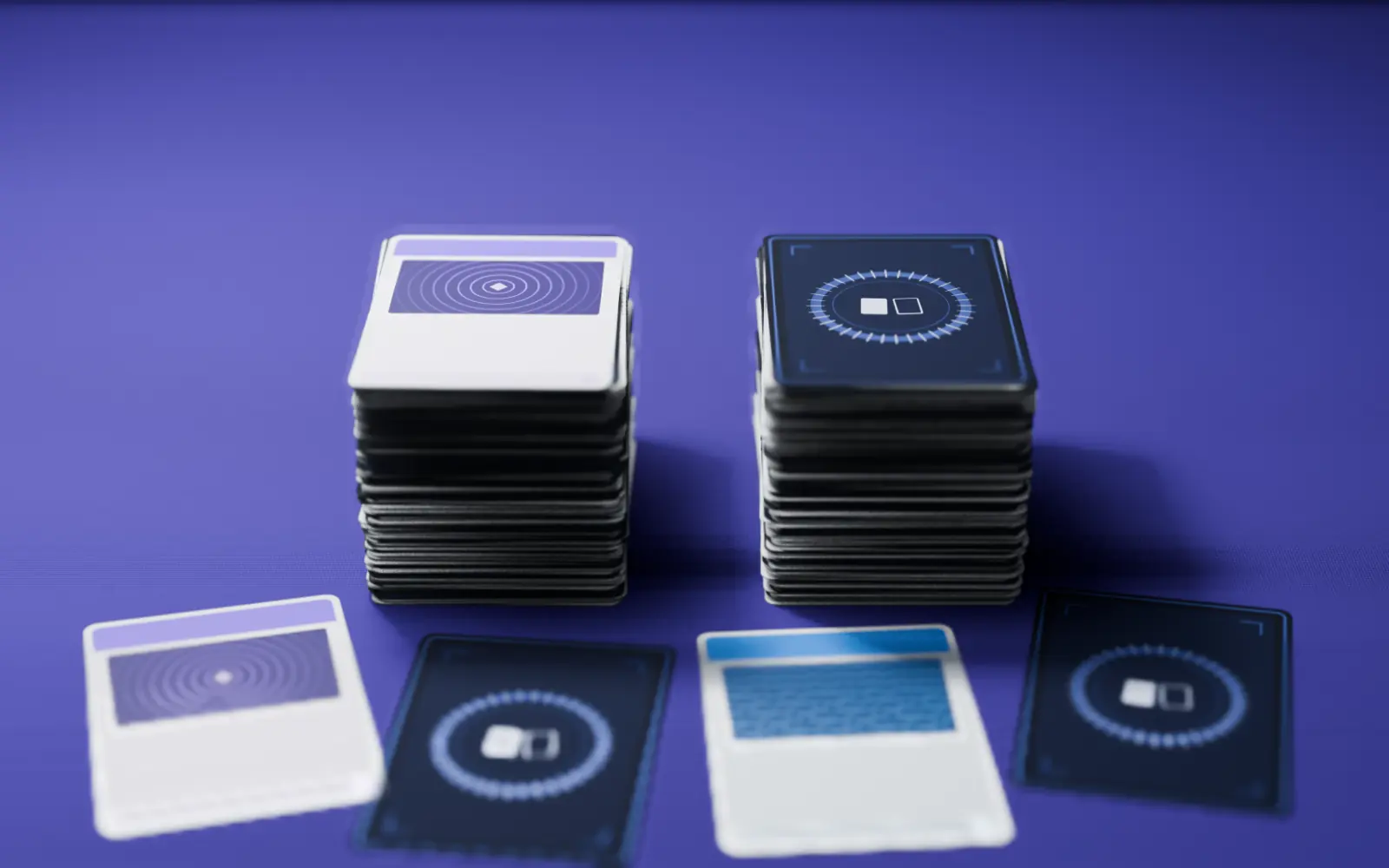
Card names come from the engine’s card catalog as text. The cards, card back, mat and marks on this site are original artwork made in Blender and Glaxnimate; no official card images are used.